
Charting Viewer Poll Impacts on Rule Tweaks in Strategy Game Leagues
Strategy game leagues have incorporated viewer polls into decision-making processes for several years, and data from multiple seasons shows measurable connections between poll outcomes and subsequent rule adjustments in titles such as StarCraft II and Dota 2, where community input shapes balance patches and tournament formats. Observers track these patterns through archived voting records and official patch notes that list community feedback as a contributing factor in specific tweaks.
Mechanisms Behind Poll Integration
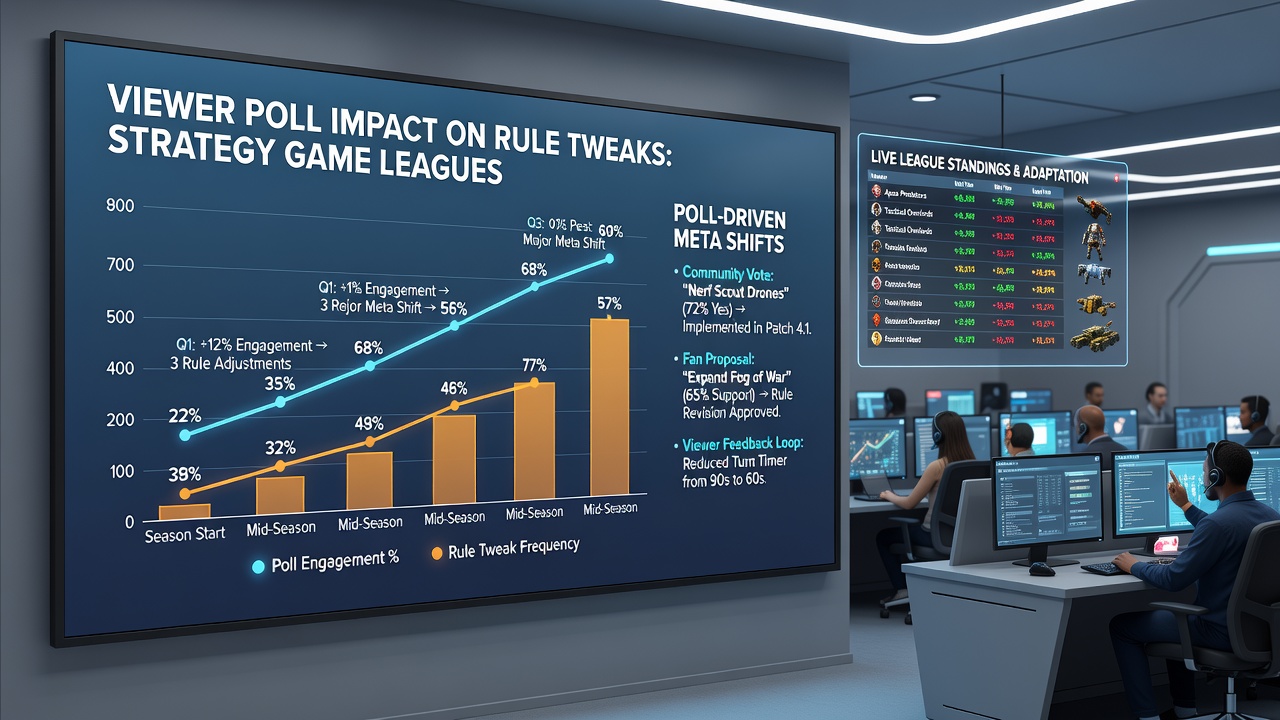
Leagues collect poll responses through official platforms during designated windows, often spanning several days before major events, and aggregate results feed into review committees that evaluate proposed changes against competitive integrity standards. Researchers have documented cases where poll majorities aligned with adjustments to unit abilities or map pools, while figures from the Global Esports Federation indicate that roughly 35 percent of rule modifications in monitored leagues during 2025 carried explicit references to viewer data in their documentation.
Turnout rates vary by region, with North American audiences participating at higher volumes than those in Asia-Pacific zones according to league transparency reports, yet implementation rates remain consistent across territories because committees apply weighted criteria that include vote margins alongside performance metrics from professional matches. This process creates traceable pathways from individual votes to final regulations.
Documented Cases of Poll-Driven Adjustments
One prominent instance occurred in a European circuit when viewer polls favored restrictions on certain hero selections, prompting organizers to limit those options in the following tournament cycle and resulting in altered win rates tracked by independent analytics firms. Another example from North American events involved map rotation changes after polls highlighted player preferences, with subsequent data revealing shifts in average game durations that matched the polled expectations.
Committees in these leagues maintain logs that cross-reference poll timestamps with patch deployment dates, allowing analysts to quantify the interval between community input and enacted rules. Studies from academic groups at institutions in Canada have examined these timelines and found average lags of four to six weeks between poll closure and official announcements.
Trends Observed Through Mid-2026
By June 2026, several leagues had expanded poll accessibility via mobile applications, which correlated with increased response volumes and more diverse demographic representation according to internal metrics released by organizers. These expansions coincided with rule tweaks addressing resource economy systems in multiple titles, where poll results directly informed threshold adjustments for in-game currencies.
Regional differences appear in how leagues weight poll data against expert opinions, with some circuits in Oceania incorporating viewer input at earlier stages of proposal development compared to counterparts elsewhere. Tracking organizations note that this variation produces distinct patterns in how quickly community-driven suggestions reach live tournaments.
Measurement of Long-Term Effects
Longitudinal reviews compare pre- and post-poll win statistics across professional rosters, revealing that certain adjustments reduced variance in match outcomes while others introduced new strategic layers that required additional patches. Data from these reviews gets published in aggregated reports that allow external parties to verify correlations without accessing proprietary league databases.
Industry associations such as the Esports Federation compile these findings into annual summaries that highlight successful integrations and areas where poll alignment with competitive results fell short of targets. Additional analysis from research institutions in Australia has explored how repeated polling cycles affect player adaptation rates in ranked environments tied to league ecosystems.
Conclusion
Viewer poll systems continue to evolve alongside strategy game leagues, with records showing ongoing refinements in how responses translate into concrete rule modifications. The combination of voting data, performance tracking, and regional considerations produces a documented framework that leagues reference when planning future adjustments, and this approach maintains transparency through public archives that connect community input to tournament regulations.