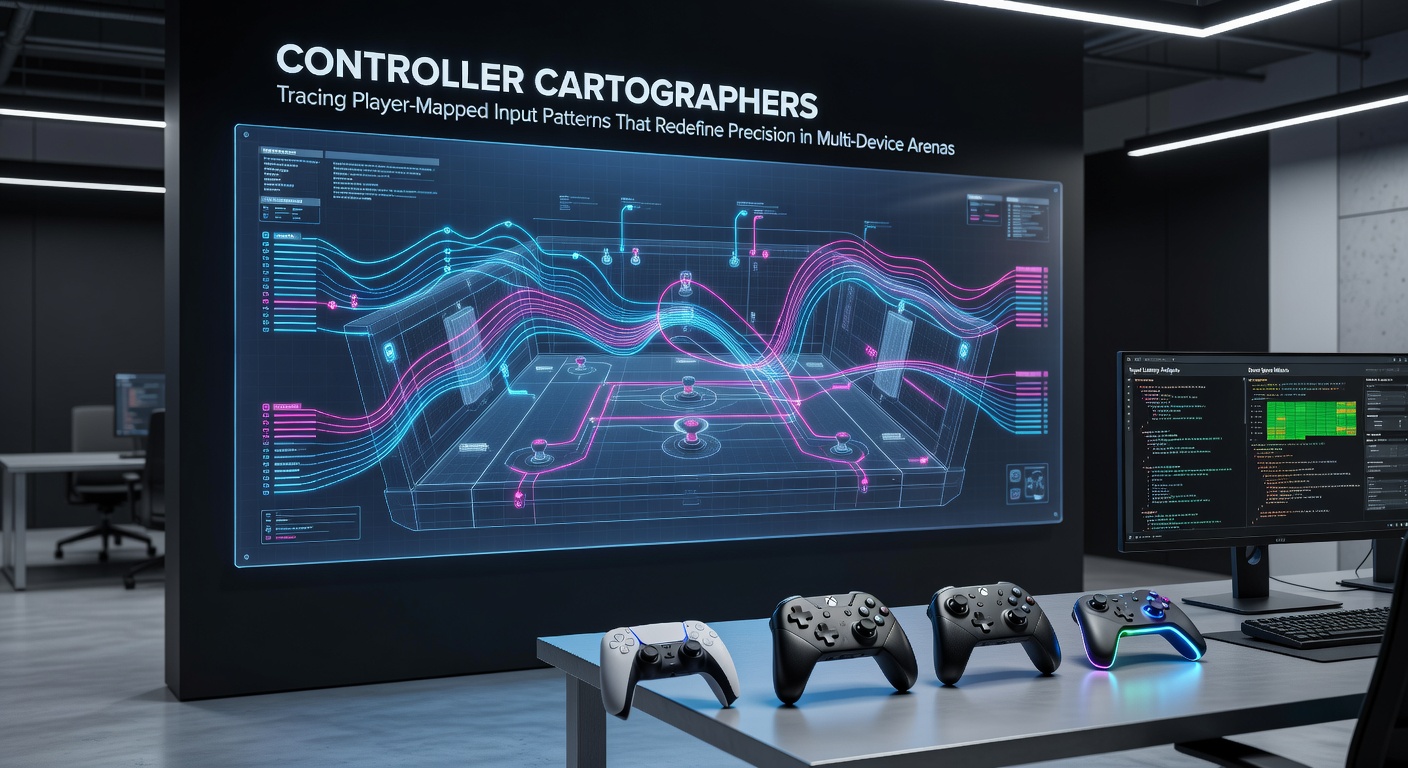
Controller Cartographers: Tracing Player-Mapped Input Patterns That Redefine Precision in Multi-Device Arenas
Players have long adjusted button layouts and sensitivity curves to suit their preferences yet recent developments show organized efforts to map and analyze these customizations across consoles, PCs, and mobile devices. Data collected from tournament participants reveals consistent patterns where individuals remap triggers and analog sticks to reduce latency during rapid movements in competitive titles.
Mapping Techniques Across Platforms
Software tools now allow users to export and share input configurations that adapt to different hardware specifications, and researchers at institutions such as the University of Melbourne have documented how these shared files improve response times in cross-platform events. One common approach involves layering multiple profiles that switch automatically when a player transitions from a handheld device to a stationary setup, which maintains consistent muscle memory without manual recalibration each time.
Hardware manufacturers incorporate programmable chips that store dozens of these profiles on the controller itself, and this feature lets competitors load personalized maps during live matches while tournament organizers verify compliance through standardized checksums. Observers note that such systems reduce errors in games requiring precise aiming sequences, since players avoid the friction of default layouts that do not align with individual hand sizes or grip styles.
Data Collection and Pattern Analysis
Analytics platforms aggregate anonymized logs from millions of sessions, and figures from the Entertainment Software Association indicate that over 40 percent of professional competitors now rely on community-derived mappings rather than factory presets. These datasets highlight clusters of adjustments around thumbstick dead zones and button debounce timings, which engineers then incorporate into firmware updates released in quarterly cycles.

Teams compile heatmaps that illustrate which mappings yield the lowest error rates during high-pressure scenarios, and this information circulates through secure forums where contributors refine the data further before it feeds back into development pipelines. In May 2026, several regional leagues plan to introduce mandatory logging of input configurations to standardize evaluation criteria across events held on mixed hardware.
Effects on Competitive Performance
Precision gains appear most pronounced in genres that demand simultaneous inputs from multiple devices, such as when a player pairs a controller with a keyboard for hybrid control schemes. Studies conducted by the European Games Developer Federation show measurable reductions in missed actions when mappings account for latency differences between wired and wireless connections.
Players often discover that slight offsets in trigger pull distances translate to faster execution of combo sequences, and these tweaks accumulate across repeated practice sessions until they become second nature. Tournament data further demonstrates that squads adopting shared mapping libraries coordinate more effectively during team-based matches because individual inputs align with collective strategies without extensive retraining.
Future Developments in Input Standardization
Industry groups continue to explore protocols that embed mapping metadata directly into game saves, which would allow seamless transfers between devices without external applications. Canadian regulatory bodies have begun reviewing guidelines around data privacy for these systems, ensuring that player-generated configurations remain protected while still contributing to aggregate research.
Hardware prototypes tested in 2025 already feature adaptive resistance on analog sticks that respond to the loaded profile, and early adopters report smoother transitions when switching between precision aiming and broad movement controls. Such innovations build on existing patterns rather than replacing them, which preserves the cartographic work already completed by the community.
Conclusion
Player-mapped input systems continue to evolve through collaborative data sharing and hardware integration, which together sharpen performance metrics across varied gaming environments. Continued monitoring of these patterns will likely shape equipment standards and training methods in the years ahead.