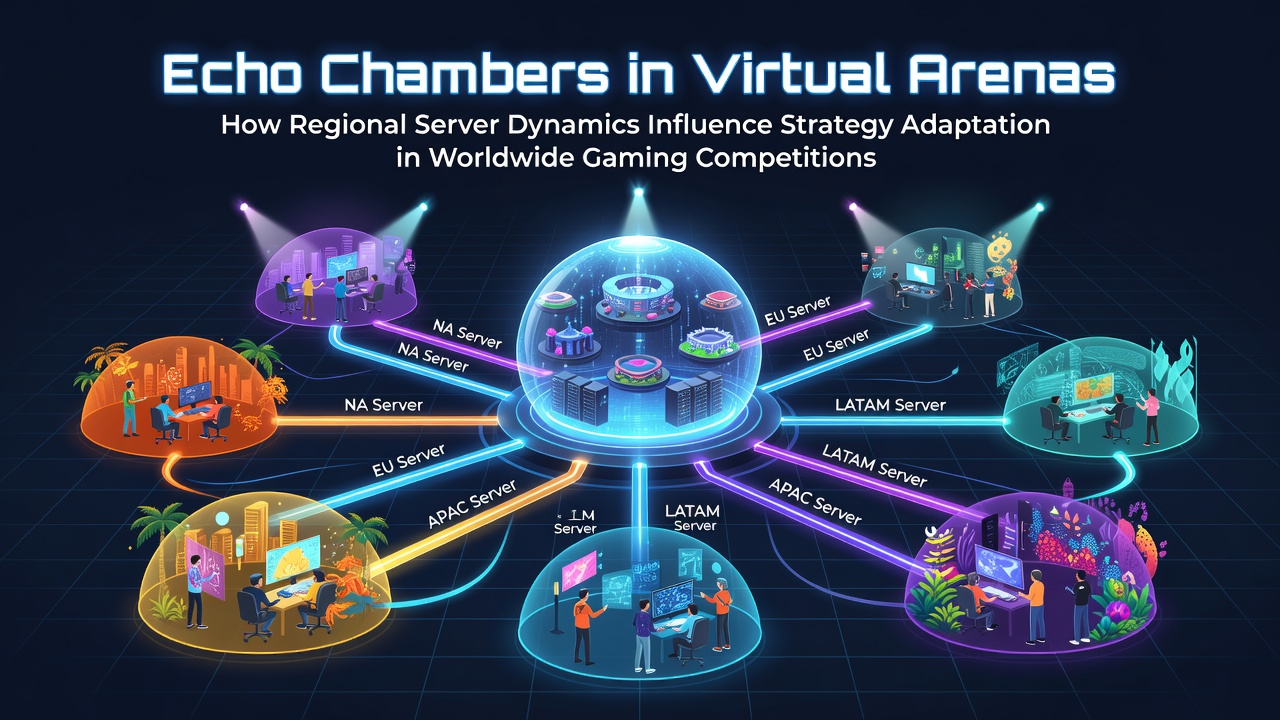
Echo Chambers in Virtual Arenas: How Regional Server Dynamics Influence Strategy Adaptation in Worldwide Gaming Competitions
Regional servers in competitive gaming create distinct environments where player populations, latency patterns, and community norms shape the development of strategies over time, and these localized approaches often carry over into international tournaments. Data collected from major titles shows that servers in East Asia tend to emphasize aggressive early-game tactics while European clusters favor defensive positioning and resource management, differences that emerge from average connection speeds, time zone alignments, and the composition of ranked player bases.
Regional Server Ecosystems and Player Behavior
Server infrastructure determines which players interact most frequently, and this repeated exposure reinforces certain playstyles while discouraging others. Observers tracking matchmaking logs note that North American servers host larger numbers of players who favor ranged characters and map control, whereas servers based in South Korea show higher pick rates for melee-focused heroes with high mobility. These patterns arise because regional populations develop preferences through thousands of matches played under similar conditions, including ping ranges between 10 and 40 milliseconds that reward specific timing windows.
Community forums and in-game voice channels further amplify these tendencies as players share replays and discuss patch changes within their time zones. Research from the University of Melbourne indicates that groups clustered on the same server adopt new mechanics faster when they share similar hardware setups and daily schedules, creating feedback loops that solidify local metas before they reach global awareness.
Formation of Strategy Echo Chambers
Echo chambers form when successful strategies on one server receive repeated validation through wins and community approval, while alternative approaches receive less testing. In titles such as League of Legends and Valorant, data logs from July 2026 reveal that players on Australian servers converged on a narrow set of utility lineups during that month's ranked season, a convergence that persisted even after balance updates introduced new options. The limited cross-server migration of players contributes to this narrowing because most competitors remain within their home regions for the majority of their matches.
Language barriers and cultural play preferences add additional layers, as teams from one linguistic region rarely review footage from another unless preparing for a major event. Figures from the Korea Esports Association show that domestic tournaments feature strategy distributions that differ measurably from those observed in North American circuits, with win rates for certain compositions varying by as much as 18 percent between regions.

Adaptation Challenges in Global Competitions
When regional teams enter worldwide events they encounter opponents whose strategies have evolved along separate paths, and adaptation becomes necessary within compressed preparation windows. Tournament organizers for the 2026 Mid-Season Invitational recorded instances where teams adjusted their draft priorities after observing scrimmages against squads from different server clusters, changes that sometimes required discarding months of domestic practice. The process involves analyzing opponent VODs for patterns that do not appear in local leaderboards, a task made more difficult by the absence of shared data formats across regions.
Coaching staffs increasingly rely on statistical modeling to predict how strategies developed in one environment will perform against those from another, yet the models remain limited by the amount of cross-regional match data available. Teams that maintain secondary rosters on foreign servers gain an advantage in exposure, although such arrangements remain uncommon due to logistical and eligibility constraints.
Evidence from Recent Tournaments and Data Sources
Match statistics compiled during the 2026 International show measurable shifts in strategy usage once teams advance past regional qualifiers. Picks that dominated home servers dropped in frequency during the group stage, replaced by compositions that accounted for the broader range of opponent tendencies. Analysts attribute these adjustments to the higher variance in player skill expression and timing that occurs when latency differences and play cultures intersect.
Studies conducted by the European Network for Digital Sports Research track how patch notes released in one region influence adoption rates elsewhere, finding that strategies originating on high-population servers spread more quickly than those developed in smaller clusters. These findings suggest that server population size functions as a predictor of meta influence in subsequent global events.
Conclusion
Regional server dynamics continue to shape the strategic landscape of competitive gaming through persistent differences in player behavior, latency conditions, and community validation mechanisms. Worldwide competitions serve as the primary points of contact where these localized approaches meet, forcing adaptation under time pressure. Continued collection of cross-server data will allow clearer mapping of how strategies migrate between regions and which factors accelerate or slow that process.