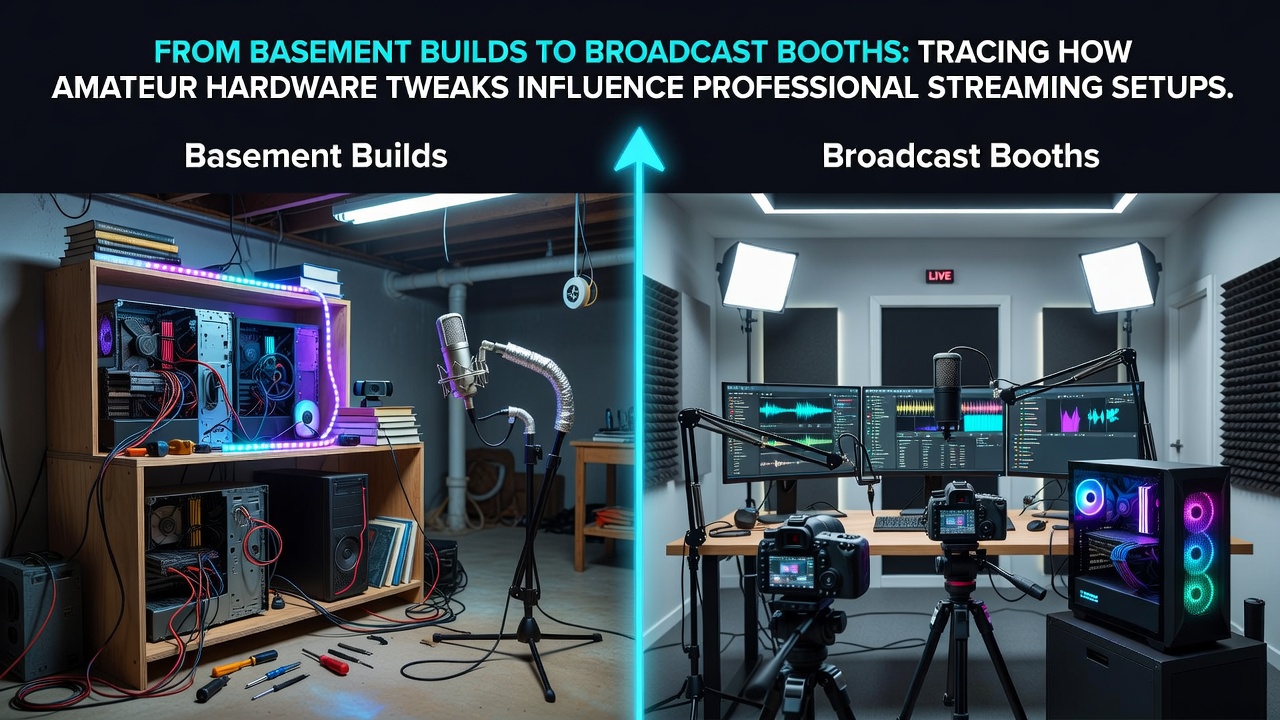
From Basement Builds to Broadcast Booths: Tracing How Amateur Hardware Tweaks Influence Professional Streaming Setups
Amateur hardware modifications have long shaped the tools that professionals rely on during live broadcasts, and this pattern continues into August 2026 as community-driven changes migrate upward through forums, shared code repositories, and open-source projects. Observers note that many core elements in modern streaming rigs trace back to experiments conducted outside formal industry channels, where individuals test encoder configurations, cooling solutions, and audio routing on limited budgets before those same approaches appear in high-end production environments.
Early Experiments in Home Setups
People who built their first capture systems in spare rooms often started with basic graphics cards paired to inexpensive motherboards, then added custom fan profiles and voltage tweaks to maintain stable frame delivery during extended sessions. These adjustments reduced dropped frames and thermal throttling, which in turn allowed longer uninterrupted streams without hardware resets. Research from university labs in North America has documented similar patterns where hobbyist overclocking data fed into later commercial encoder optimizations released by chip manufacturers.
Audio interfaces followed a parallel path. Basement builders frequently combined multiple USB microphones with software mixers to isolate voice, game audio, and background tracks, creating layered outputs that commercial broadcast software later adopted as preset templates. Data from industry reports compiled in 2025 show that several popular digital audio workstation plugins used by major platforms originated in code snippets posted on community sites before receiving professional polish and licensing.
Transmission of Tweaks to Professional Environments
Forum threads and video walkthroughs serve as primary vectors for these transfers. A tweak developed for low-latency capture on consumer GPUs can appear in a tournament production truck within months once a single operator tests it during an amateur event and shares results. According to figures released by the Entertainment Software Association, participation in hardware modification discussions has grown steadily, with measurable overlap between active contributors and staff employed at broadcast facilities for major esports leagues.
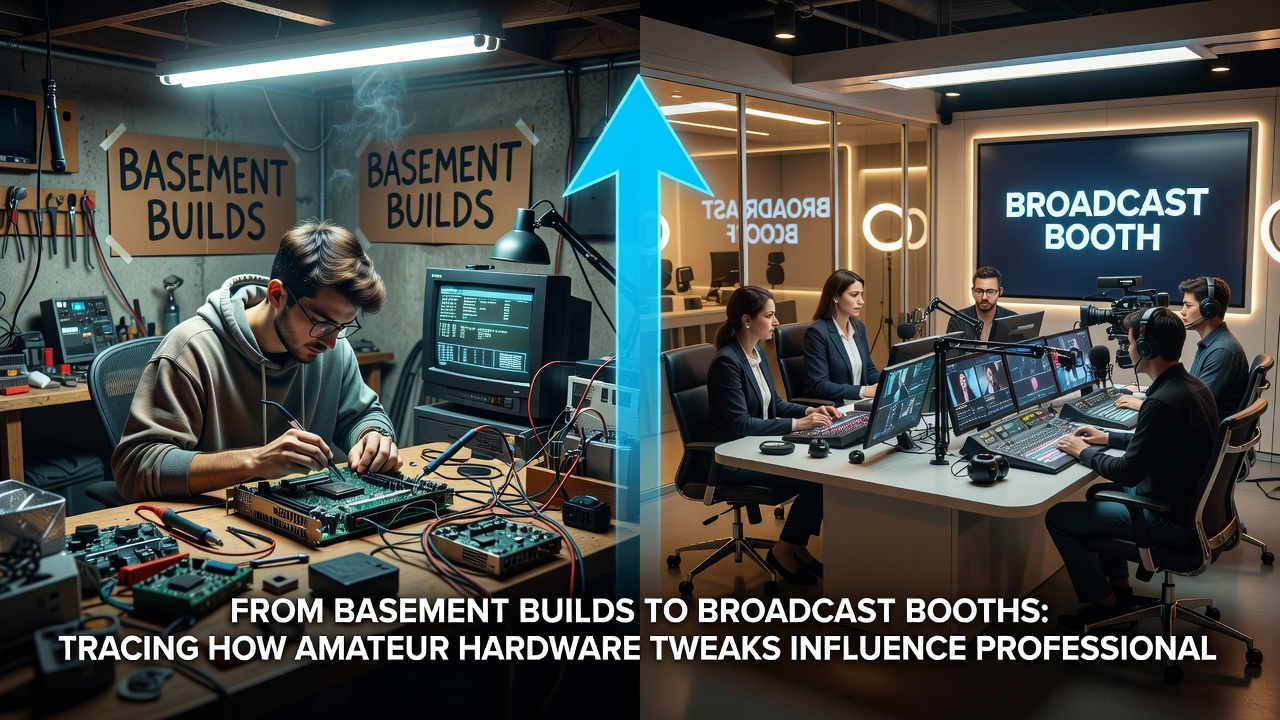
Lighting rigs provide another clear example. Hobbyists who constructed modular LED arrays using off-the-shelf parts and open-source control software demonstrated improved color consistency and lower power draw compared with early commercial kits. Production teams at established networks reviewed those builds, then commissioned scaled versions that retain the same modular connectors and firmware logic. European trade data collected by the Interactive Software Federation of Europe indicates rising adoption of such hybrid lighting solutions across continental studios since 2024.
Current Patterns Observed in August 2026
By August 2026, several professional streaming operations integrate encoder presets first refined in home labs for handling variable bitrate streams across mixed resolution feeds. These presets allow simultaneous 1080p and 4K outputs without additional hardware transcoders, cutting rack space and cooling requirements in mobile broadcast units. Technicians who previously worked on personal projects now apply the same monitoring scripts to track packet loss in real time during live events.
Case examples include regional tournaments where volunteer crews used repurposed server cooling components to stabilize GPU loads in temporary booths, after which full-time production staff incorporated identical mounting hardware into permanent facilities. Such migrations occur because the underlying constraints of heat management and signal integrity remain consistent whether the setup occupies a garage or a dedicated arena control room.
Documentation and Standardization Efforts
Archivists and researchers have begun cataloging these transitions through public repositories that track commit histories of streaming-related software. One study conducted at a Canadian institution examined how community-submitted pull requests altered default settings in widely used broadcast applications, finding that performance gains first measured on consumer hardware later became default options in enterprise versions. This documentation process helps both sides recognize which modifications survive scaling and which require further engineering.
Hardware vendors have responded by releasing developer kits that mirror the modular approach hobbyists already employ, complete with exposed APIs for custom scripting. Adoption rates appear in quarterly sales summaries from multiple regions, showing increased purchases of components previously favored only in non-commercial builds.
Conclusion
The movement from individual experimentation to broadcast-standard equipment follows a consistent route of testing, sharing, and refinement. Metrics collected through 2026 confirm that many elements now standard in professional streaming booths first appeared in projects developed outside institutional settings, with the flow of ideas remaining active as new constraints emerge in higher-resolution and multi-platform delivery.